OFFER: A BRAND NEW SERIES AND 2 FREEBIES FOR YOU!
Grab my new series, "Western Brides and True Loves", and get 2 FREE novels as a gift! Have a look here!
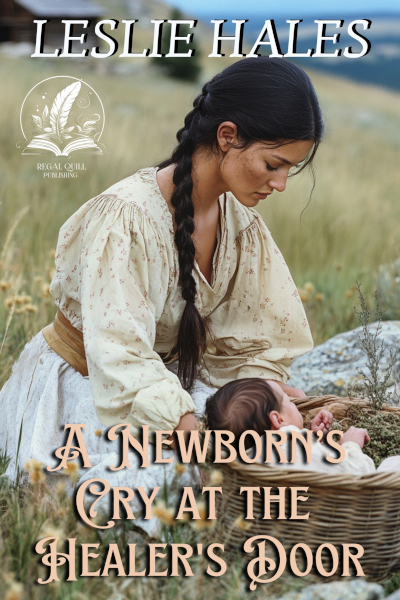
Chapter One
Buffalo, Wyoming, 1880
It was getting dark as Thalia hauled the water bucket up the path. It was already March, early spring, the time when the ground was still cold, but the air carried the first hint of thaw. Melted snow trickled down from the ridge, turning the creek fast and noisy, and the wind had that sharp, wet smell that meant the season was shifting for good.
She paused to catch her breath, the bucket handle biting into her fingers, and listened to the soft creak of the trees waking up after winter. She set the bucket inside the cabin door and went straight to the garden. The ridge soil was stubborn, but she had coaxed enough from it to keep herself fed. Tonight she covered the beds with old canvas sheets, weighing down the corners with stones. A hard frost could still come before dawn. It had happened before and she couldn’t risk it happening again.
Up here, the weather didn’t care if a woman lived or died.
When she finished with the garden, she checked the snare line, then went inside and barred the cabin door. The bar slid into place with a solid thud. And only then did she allow herself to relax. She trusted wood and iron a lot more than she trusted people. Five years alone in the woods had taught her that much.
Inside, everything sat where it belonged. Sparse, perhaps, but ordered and clean. There was a small bed against the far wall, a small table between the kitchen and the living area, and a single shelf with folded blankets, kerosene, some extra wicks, candles, and a few tools. Nothing extra. Nothing she couldn’t carry with her if she needed to leave in a hurry.
This was the way she’d lived since the beating that nearly killed her five years ago, since the scars on the left side of her face had healed into a map she never asked for.
Then she ate standing, as she often did. A piece of cornbread, a strip of dried meat, and the last of the boiled potatoes. When she finished, she washed her plate and set it back on the shelf. No clutter. No loose ends.
Most of her hair, black and heavy, had already come loose from its tie. She took the tie off and slipped it between her teeth as she sat on the edge of the bed. She gave her hair a quick brush, then braided it for sleep. Her fingers moved with speed, having performed the task more times than she could count. She didn’t even need to look.
Her hands were especially rough from all the years of hard work—hauling water, cutting wood, tending the ridge alone. Normally, she didn’t mind. Soft hands had never kept anyone alive. But her calluses were annoying—snagging on her hair, the linens, and even the edges of her dress. So, she opened a tin of salve that she’d made from beeswax and pine resin and smoothed some on her hands.
When that was done, she laid back on the bed and let herself breathe for a moment. Softly, she began to sing the lullaby that her mother had taught her when she was a girl. Arapaho words, familiar and comforting, filled the small cabin. She sang it every night so she wouldn’t forget the words. It was the only moment she allowed herself to feel anything beyond the work of survival.
But tonight, halfway through the second verse, a sound cut through the ridge.
A baby’s cry.
Thalia froze. She had to be mistaken. Maybe it was a coyote pup or a mountain lion cub. Then she heard it again. The sound was faint, carried on the wind from somewhere below the ridge. She listened hard, thinking she had imagined it. But the third time it came again, it was unmistakable.
A baby. Out there.
This was confusing. She was confused. She couldn’t imagine why a family with a small baby would be traveling through the woods—her woods—this late at night. Then it struck her. Someone might be sick or injured, looking for a healer. Looking for her.
The bed nearly collapsed beneath her as she jumped out and ran toward the kitchen. She snatched her medicine bag from beneath the cabinet and looped it around her shoulder. Her rifle hung on the wall, and she grabbed it on the way out without thinking. She didn’t bother with a coat or any shoes. She didn’t even bother getting dressed.
She stepped outside in her nightgown, the cold air hitting her full in the face, and followed the sound down the narrow trail. It was cold, but she barely felt it. Her only thought was that someone needed her help in a bad way, and she was determined to get to them.
The ridge was dark, the moon only a sliver in the night sky. She moved by memory, feet sure on the path she’d walked a thousand times before. The cry came again, louder this time, and her heart thudded in her chest. She broke into a run, her hair whipping behind her.
A new thought came to her—hardly anyone knew she lived on the ridge except a few close friends and a trader who passed through twice a year. How would they know how to get to her? Most folks couldn’t find her in the daylight, much less in the dark at night.
Finally, she reached the base of the path and came to an abrupt stop.
There, tucked against the trunk of a young pine, lay a small bundle wrapped in a wool blanket. The crying had weakened to a thin whimper by the time she reached it. Thalia knelt, rifle still in hand, and pulled back the edge of the blanket.
A newborn. She couldn’t tell much more than that at first blush. Its skin was mottled from the cold, its tiny fists trembling. She couldn’t have been more than a few days old. Maybe even only one.
She scooped it up and clutched it tightly to her chest. Only then did she see the note pinned to the blanket on a scrap of paper.
Take care of her and keep her hidden. No one can know. Her life depends on it.
Thalia stared at the note until the words blurred. Her pulse hammered in her ears. She looked around the clearing, half expecting someone to step out of the shadows. But the ridge was silent. Until a lone coyote howled in the distance.
“Shh,” she hushed the crying infant. Coyotes were nearby and she didn’t want to test her rifle against a full pack. “Hush now. It’s all right.”
She cuddled the baby closer, tucking its cold face into the warmth of her neck. The child was freezing.
Thalia stood and headed back toward her house. Normally, the forest felt quiet, familiar. But tonight, she jumped at every sound. She picked up her pace. But then, a bob cat growled from somewhere behind her, and the hair on her neck stood up. She didn’t think. She didn’t hesitate. She ran. Barefoot and all.
Back up the trail, breath burning in her lungs, rifle slung over her shoulder, the baby held tight against her chest. She reached the cabin and ran inside, shoving the door closed and dropping the bar into place. She was home. They were safe.
She leaned her back against the door and tried to catch her breath. The baby whimpered again, weaker this time.
“Stay with me,” Thalia panted. “We’re safe now.”
She set the rifle aside and went to work. She lit the stove, fed it kindling, and wrapped the baby in the warmest blanket she owned. Then, she heated some water, tested it with her wrist, and cleaned the child as gently as she could. The baby’s skin was still cold as river stone.
“Shh. You’re all right now,” she cooed as she continued washing the baby with the warm water. Finally, the infant started to regain some color and was now biting on its little fist. “Now, you just need a change.”
Thalia covered the baby, then put the water away. She searched the cabin for anything she could use as a diaper—old shirts, scraps of muslin, anything soft enough and absorbent enough. She tore the fabric into strips and folded them tight. She held up one of the scraps and examined it closely. It wasn’t pretty, but it would work.
“There you go,” she told the baby as she fastened the diaper pin. “Now, what are we going to feed you? I have beans and cornbread, but I don’t think that’s what you want, little one.”
She cut her eyes to the kitchen, thinking as she eyed the cupboards. There was a small pantry attached, but she only had some dry goods and a few vegetables in there. Sadly, she had no milk. No goat. No cow. Nothing.
Wait. Sugar! She had sugar.
“You stay here. I’ll fix something up for you,” she said, tucking the covers around her.
Hurrying to the kitchen, she took down a cup and mixed some sugar with the rest of the warm water to make a thin syrup. She hurried back over to the bed and scooped the baby into her arms. Then, she dipped a clean rag into the syrup and placed it in the baby’s mouth. She sucked weakly on the rag. It wasn’t enough, but it was something, at least.
Hours passed. The fire burned low. Thalia napped in between feedings, getting up every couple of hours to heat water, make the syrup, feed the baby, and change her diaper. In between feedings, she caught herself waking up just to check the baby’s breathing and make sure she was warm enough. It was a long night.
She didn’t let herself think too hard about the note yet. Or the danger. Or the fact that someone had climbed the ridge in the dark to leave a newborn at her doorstep. None of that really mattered right then. All that mattered was making sure the baby survived the night. It was a miracle the coyotes or the mountain lions hadn’t gotten to her before Thalia did.
By morning, the baby was still alive.
She wouldn’t have said it was thriving. But it was alive.
Thalia sat on the bed, the baby still wrapped in the blanket and tucked against her chest. She ran her hand gently over the blanket, soft wool dyed in deep reds and warm golds, and the pattern woven in the old way, tight and even.
She remembered the day her best friend, Niwot, had given it to her. They’d known each other since they were children and he knew exactly how her tastes ran. She wished he was there now.
He’d handed her the blanket without ceremony, saying only that her mother would have wanted her to have something made by her own people. She hadn’t understood how important it would be to her then, not fully. She did now.
The baby’s breathing was thin and reedy, her tiny fingers curling around the edge of Thalia’s shirt. The bright colors of the blanket looked almost too bold against the infant’s small, fragile body, but Thalia held her closer, grateful for the warmth of it.
Thalia rocked her gently, the motion strange after so many years alone. She’d rocked many babies when she was young and still practiced at healing. But that seemed like another lifetime ago. She couldn’t really call herself a healer anymore. Not when she had no patients.
The baby’s dark eyes blinked open for a moment, unfocused, then slowly closed again. Thalia took a moment to admire the baby’s head of black curls. And after seeing the baby’s dark eyes—much like hers—she wondered briefly if the baby was Arapaho, too. But she couldn’t imagine an Arapaho mother ever abandoning her child.
Thalia looked down at the sweet bundle in her arms and felt something warm inside her. This sweet, precious little girl was all alone in the world, not a soul to watch out for her. And suddenly, Thalia felt something else.
Responsibility.
She had no milk. No supplies. No idea who had left this child or who might come looking for her. But it was up to her to protect her. She’d do that alone. After all, she had no reason to trust anyone else. She’d survived the last five years of her life without letting another soul get close. She wouldn’t let anyone hurt her again.
But she wouldn’t turn this baby away.
The ridge was no place for a newborn. But the world below wasn’t much better. Whoever had left her had done so in desperation. Or fear. Or both. She couldn’t imagine what might drive a woman to abandon her newborn. Whatever it was, she must have been terrified. Maybe she thought this was the only way to save her.
And for some reason, fate had chosen Thalia to take care of this baby. To take responsibility for that tiny life.
Thalia tightened her hold on the baby and thought about the next problem facing her.
Milk. And she’d need a constant supply.
Chapter Two
“Mornin’.”
Josh Croft pushed open the door of the general store just as the shopkeeper was setting out the daily ledger. The sun had barely cleared the rooftops outside, but Josh had been in the saddle since before first light. His jaw was tight, and he didn’t bother with any further niceties.
“Morning,” the man replied.
“I’m Josh Croft from over near Sheridan” “I’m looking for my sister.” Josh told him. His voice came out rougher than he meant for it to. “Her name’s Hannah. We live out closer to Sheridan. Hannah came into town yesterday morning looking for work and hasn’t come home.”
“Well, I’m sorry to hear that. I’m Jonathan Garrett,” he said, adjusting his spectacles. “I haven’t seen her, but I’ll keep an eye out for her. Try over at the seamstress’ shop. Or the church. I think they had their monthly social there last night. She might’ve gotten to talking to those ladies and lost track of time.”
Josh didn’t answer. But he decided to check it out. He tipped his hat, thanked Mr. Garrett, and left.
Stepping back outside, he saw the town was waking up—lamps being snuffed, doors opening, a few men sweeping their storefronts. Josh stood in the middle of the road, hands on his hips, trying to draw up a plan of attack in his head. He’d spent the whole ride into town telling himself there was an explanation. A simple one. But he just couldn’t make himself believe it. Something was wrong.
Hannah wasn’t careless. She wasn’t the kind to stay out all night without sending word to him or their pa. And she sure wasn’t the kind to disappear.
Sighing, he turned and headed for the seamstress’ shop first.
An hour later, he’d spoken to the seamstress, the liveryman, the saloon keeper, and half a dozen other patrons. Every answer led nowhere.
“Yes, she came in but left promptly.”
“No, not yesterday.”
“No, can’t help you.”
These folks seemed like wholesome people. But Josh couldn’t help but question their honesty. He hated it, but some of them seemed to look away too fast or refuse to meet his eyes. Others seemed honest enough. But someone had to know something about Hannah.
Josh had always heard talk about the corruption in Buffalo. Folks said the law bent easy there, depending on who you were and who you knew. That was why the Crofts went to Sheridan whenever they needed anything important. Josh, Daniel, and Hannah had all gone to school in Sheridan too. Their pa always did his business in Sheridan, and they only came to Buffalo when they had no choice.
Riding around the town now, Josh saw a few familiar faces but not many. Most people looked right past him like they didn’t know him. Mainly because they didn’t. But today it made something tight settle in his chest. He’d never felt so much an outsider as when he started asking around about Hannah.
He went from shop to shop, stable to stable, asking about her, sharing her description, and trying not to ruffle any feathers. Some folks were polite enough, shaking their heads, saying they hadn’t seen her. Others barely looked at him before mumbling something and turning away. A few acted like he was bothering them just by speaking.
At the boardinghouse, the clerk didn’t even try to hide his annoyance. “Girls come and go,” he’d said, shrugging like Hannah was nothing more than a stray cat. Josh had to bite down hard on his temper to keep from reaching across the counter.
By the time he stepped back out onto the street, he felt worn thin. This town felt wrong. It was tightlipped and watchful, like everyone knew something he didn’t. He kept wondering if Hannah had felt it, too, as she wandered around, looking for work.
Buffalo wasn’t a good place to hang your hat. He knew that. But now, with Hannah missing and no one willing to help, the truth of it settled deep in his bones.
He’d made a huge mistake letting Hannah come out here alone. Now he just had to set things right.
By the time he reached the sheriff’s office, his patience was stretched as thin as creek ice in spring.
A sign out front told him this was the office of Sheriff Alton Roberts. Opening the door, Josh strode inside.
Sheriff Roberts sat behind his desk, boots up, hat tipped back. He was a thick man in his fifties with a gray mustache and a belly that tested the mettle of his vest buttons. His badge was polished bright, and his eyes were sharp in a way that said he missed little—but cared even less.
Josh didn’t wait to be invited in. He also waived all the polite niceties. “Sheriff, I need your help,” he said, walking closer to Sheriff Roberts’ desk.
The sheriff took a deep breath, then gave Josh his full attention before exhaling it. He didn’t look too impressed by Josh’s presence. In fact, it seemed like a gnat might be more welcome. “Do tell, son.”
His lack of interest was clear. But Josh had a duty. So, he explained. “My name’s Josh Croft. My pa has a ranch just outside of town—”
“I know it,” the sheriff interrupted.
Josh blinked. “Well, it’s my sister, Hannah. She didn’t come home last night.”
Roberts lowered his boots to the floor. “Your sister?”
“Yes. Hannah,” he repeated.
“How old is she now?”
“Twenty.”
Roberts nodded slowly, as if that settled something. “All right. Tell me what happened.”
Josh told him everything—when she left, where she said she was going, who he’d spoken to already this morning. Roberts listened, but his bored expression never changed.
When Josh finished, the sheriff leaned back in his chair again. “Son, I run a peaceful town here. There’s been no sign of any trouble. No struggle. No witness account of anything wrong or illegal. If I had to guess, she’s probably holed up somewhere with a fella”
“She wouldn’t do that,” Josh said through gritted teeth. “She’s not like that.”
“Like what? Human?”
“She wouldn’t go off with some fella like that. She’s a good girl,” Josh explained. “And she wouldn’t stay out all night without letting me know where she was.”
“Your sister is a grown woman,” Roberts pointed out. “Twenty years is plenty old enough to go wherever she dang well pleases—without your permission. Now, I haven’t heard anything that makes me think there’s any foul play going on here.”
It was Josh’s turn to take a deep breath. He was fighting the urge to walk over and dump Sheriff Roberts out of his chair. Maybe that would get him up off his lazy behind. But that wasn’t going to get him anywhere except a jail cell.
The sheriff leaned forward and laced his fingers together, resting them on his desk. “Look, just give her some time. She’ll probably be there waiting for you when you get home, and you’ll feel foolish when she tells you where she’s been.”
“She didn’t go anywhere,” Josh snapped. “Something’s happened.”
Roberts’ eyes hardened. “Your sister is your responsibility, Mr. Croft. Watching over her is your job. If you were going to fret like a mother hen, maybe you shouldn’t have let her ride into town alone.”
Josh took the words like a blow and his jaw locked hard. Maybe the sheriff was right, but that didn’t change a thing—Hannah was gone, and she needed help. “Your job is to see that the folks in this town come to no harm,” he said. “Or to no bad end. Maybe we both failed to do our job?”
Sheriff Roberts squinted at him. “A twenty-year-old girl is late getting home. That’s hardly a sign of trouble or that she’s come to some tragic end,” Roberts scoffed. “I’ll keep my eyes open, just in case. But that’s all I can promise right now. If she doesn’t show up, come back and see me in a couple of days.”
It was all Josh could do not to reach across the desk and throttle Sheriff Roberts where he sat. But Josh didn’t say anything else. There was no point. This was the reason his family had chosen to do their business in the town of Sheridan, even though Buffalo was closer. The town had a reputation for corruption. The sheriff’s tone made it clear that he considered the matter closed.
Josh stared at him for a long moment, letting his anger be known without saying another thing. Then, he turned and walked out before he did something he couldn’t take back, and maybe even landed behind bars.
Outside, he stood on the boardwalk, breathing hard. The sheriff’s words echoed in his head, but worse were the ones he’d already been telling himself.
Like, You should’ve gone with her. Or, You should’ve kept her safe. Or, You should’ve known something was wrong.
Well, he hadn’t done any of those things yesterday. But he would today. He’d fix this. He had to. Sitting around waiting for answers wasn’t going to bring Hannah home. He swung into the saddle and rode north out of town with no plan except to cover ground. If she wasn’t in town, she had to be somewhere. Maybe she’d taken a wrong trail. Maybe her horse had thrown her. Maybe—
He cut off the thought. He didn’t want to imagine the rest.
The farther he rode, the more the land opened up. The landscape was wide and empty in every direction. The trails thinned until they were little more than worn paths between sagebrush. The ground turned rough, broken by rock and dry washes. He pushed Thunder harder than he should have, but he couldn’t slow down. Hannah could be out here, hurt or scared or worse.
“Come on, Thunder,” he said, patting the horse’s neck. “Help me find her.”
He kept scanning the ground—hoofprints, broken brush, anything. But the wind had picked up overnight and would have wiped away signs as fast as they were made. He tried calling her name a few times, but his voice felt small in all that open country.
He reached the foothills near the ridge, the place where the land started climbing toward the high country. Thunder’s breathing had grown rough, but Josh urged him on. He didn’t care about the ache in his own legs or the tightness in his back. He only cared about finding Hannah.
Thunder stumbled on loose rock.
Josh felt the ground drop out from under him. One moment he was sitting tall in the saddle. The next moment, the world pitched sideways and he went flying. Everything spun past in a blur that lasted only seconds. Then he hit the ground—hard. His head bounced off a large boulder and a landed in a heap with the breath knocked out of him.
He tried to pull in air, tried to push himself up, but the world tilted again.
Everything went black.
***
He drifted in and out of consciousness. Cold seeped into him, and pain throbbed behind his eyes. He tried to move but couldn’t tell if he actually did or not. His limbs felt heavy, like they belonged to someone else. Every breath scraped at his ribs.
Time slipped past. He didn’t know if it was minutes that went by or hours.
At some point, he heard a voice. It was a woman’s voice, and she was singing something low and unfamiliar. The words didn’t make sense, but the sound was steady, almost soothing. It wrapped around him like a warm blanket, pulling him under. He tried to open his eyes, but they wouldn’t obey.
He was certain he was dreaming it.
He slipped under again.
When he woke up the next time, the singing was closer. Same voice, different song. He felt a hand on his forehead, cool and soft. Someone murmured something he couldn’t catch. He opened his mouth and tried to speak, but his tongue felt thick, like it was too big for his mouth. His mouth was dry as dust.
A shadow moved above him. He caught a glimpse of long, black hair, a braid maybe, but the image wavered and broke apart. His head pounded with every heartbeat.
He tried to lift his hand. It twitched or, at least, he imagined it did.
The voice came again. It was gentle and patient. Familiar. And this time, he understood the words.
“Easy now. Don’t try to move,” the woman with the long, dark braid said. “You took a bad spill.”
He tried to pry open his eyes, but they barely fluttered. She dabbed at his forehead with a cool cloth.
“You’re hurt,” she went on. “Your head’s bleeding, and you’ve been out for a while. You need to rest.”
He tried to speak, to ask about Hannah, but his mouth wouldn’t cooperate. The words were slurred and syrupy.
“I’m going to give you something for the pain,” she said. “It’ll help.”
He felt her lift his head a little. Something pressed against his lips.
“Open your mouth, just a little,” she told him.
Somehow, he managed it. Or she opened it for him. A bitter liquid slid over his tongue, thick and earthy. He coughed weakly and tried not to spit it back out. But she kept a hand behind his head until he swallowed.
“There,” she said softly. “That’s good. Let it work.”
Her voice drifted in and out, like he was hearing her from far away. He was frustrated, wanting to ask who she was. He wanted to ask where his horse was and if she’d seen his sister. But he couldn’t do any of these things.
“You’re safe,” the woman said, her tone kind and reassuring. “And you’re lucky to be alive.”
He tried to nod but wasn’t sure if he managed it.
The pain dulled, spreading out into something warm and numbing. Her hand stayed on his forehead, anchoring him to the world.
“Sleep now,” she said. “That’s all you need to do.”
He slipped under again.
***
When he woke, it was to firelight flickering across the ceiling. His head pounded. His mouth was dry. He blinked, trying to make sense of where he was.
A cabin. Small. Comfortable. Warm.
He shifted, and the movement sent pain shooting through his skull.
“Try not to move too fast,” the woman said. “You knocked your head pretty good.”
Slowly, Josh turned and finally saw her.
A woman sat in a rocking chair near the stove, feeding a baby that was wrapped in a deerskin blanket. Her hair was black and rested across her shoulder in one long, thick braid. Her skin was brown, and the left side of her face was scarred—old scars, pale against her cheek and jaw.
She was Indian—Arapaho, if he had to guess. There were several families living in their parts. She might not have been full Arapaho, but there was no doubt about her heritage.
Dark, sad eyes stared back at him. He got the feeling she was generally unhappy. But for what reason, he couldn’t guess. Maybe it had something to do with the scars on her face. Or having a strange man in her bed. She sat there, rocking and watching him without fear as she fed the baby with a bottle.
She didn’t look away. She didn’t apologize for staring. She simply studied him, as if deciding whether he was worth all the trouble.
Finally, Josh swallowed. His voice came out rough when he asked, “Where am I?”
“In my cabin,” she said.
“What happened?”
“You fell,” she said. “Your horse came back down the ridge without you.”
Yes, he remembered now. He remembered flying, then hitting the ground. Landing on his head, which was still pounding. He tried to sit up again, slower this time. “How long have I been out?”
“Two days.”
His eyes widened. Two days? Pa would be worried sick. And he’d lost two days he could have been searching for Hannah. Or maybe she was home by now.
“Thunder?” he murmured.
Thalia frowned. “Sky’s clear.”
“No. My horse,” he clarified.
“Oh. He’s fine.” She chuckled. “He’s right outside. I put your tack in my shed. Though, you won’t be needing it for a few more days.”
“I appreciate what you’ve done for me. But I have to go,” he told her, trying to shift his legs out of bed. They felt like broken sticks.
“You’re not going anywhere right now. Lie back or I’ll have to tie you to the bed,” she said firmly.
He looked at her and blinked. For a small woman, she was certainly intimidating. He did what she said—more because he wasn’t sure if he could stand up yet than from fear of being tied to the bed.
“With the knock to your head…” she explained, “And I’m not too sure you haven’t broken your leg. You don’t need to be on a horse just yet.”
Flipping the blanket off his legs again, he looked down at them, frowning. They looked all right, but the left one wasn’t behaving like it should. She might have been right. He wasn’t sure he could stand up straight even if his leg wasn’t busted. Just sitting up felt like a feat and the room had already begun to spin. For now, he gave up on the notion of leaving.
“Are you hurting?” the woman asked as she set the bottle on a table and raised the infant to her shoulder. He watched, mesmerized, as she began to pat its back. “I’ll assume that means yes,” she said when he didn’t answer.
“That belong to you?” he asked, still staring at the baby in her arms.
“No,” she replied. Then quickly added, “She’s my niece.”
She didn’t offer more, and he didn’t ask. Instead, he pressed a hand to his forehead. “I need to get back out there. I need to find my sister.”
The woman didn’t move from her chair. “You’re in no shape to ride.”
“I don’t have a choice.”
“You do,” she said. “You can stay alive long enough to look for her.”
Her tone was flat, practical. Not unkind. Just matter of fact.
Josh let his head fall gently back against the pillow. The room swayed and he closed his eyes, trying not to focus on the pain.
“I’ll get you some more medicine for the pain,” she said, reading his mind. Or maybe just reading the way his face was pinched. “You have a fever too.”
She stood and crossed to the old sofa, laying the infant on its stomach and giving its back a gentle pat before heading into the kitchen. With her back to him, she took down a couple of tins and began crushing and mixing some plants from her indoor garden.
He forced his eyes open a little more and watched her. She had her back to him, her hands busy at the counter while she hummed that same, unfamiliar tune. She moved with purpose, like she’d done this a hundred times before. Her braid swung back and forth as she moved, reminding him of a pendulum. Every now and then, she paused to check a jar or measure out a pinch of something.
He was curious, so he asked her, “Is that a Crow song?”
She froze at once. He heard a bottle hit the counter hard. Even in his dazed state, he knew he’d said the wrong thing. He’d obviously hit a tender spot.
“No,” she said, her tone calm but cold. “It’s Arapaho.”
He blinked, trying to focus on her shape. “I’m sorry,” he said. “I might should have known that.”
“It’s fine,” was all she said. Then, carried on with her work.
It was a minute before he spoke again, unable to hold it back.
“Who are you?” he blurted, only then realizing how rude that sounded. He quickly tried to correct his wording. “I mean, what’s your name?”
She turned around slowly, as if deciding whether or not to trust him. When her eyes met his, they were guarded.
“My name is Thalia.”
She hesitated, then stepped closer so he could see her better. “I’m a healer. I found you on the ground at the bottom of the ridge two days ago,” she added quietly. “You were bleeding and out cold. I brought you in here so you wouldn’t die out there.”
Josh tried to push himself up, but pain shot through his skull, and he fell back with a groan. Thalia reached out on instinct, steadying him with a hand on his shoulder.
“Don’t try to sit up,” she said. “Your head’s still in bad shape. You need to lie still.”
He let out a shaky breath, the room tilting again. Thalia didn’t look away.
“You’re safe,” she said, softer this time. “Go back to sleep.”
OFFER: A BRAND NEW SERIES AND 2 FREEBIES FOR YOU!
Grab my new series, "Western Brides and True Loves", and get 2 FREE novels as a gift! Have a look here!
Hello my dears, I hope you were intrigued by the preview of this inspiring love story and you cannot wait to read the rest! Let me know your thoughts here. Thank you kindly! Happy reading! ✨